Meaningful Conversation Starters: Printable Deep Questions
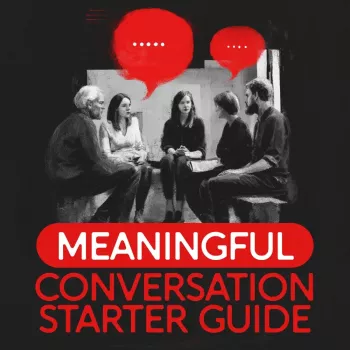
Meaningful Conversation Starters: A Printable Guide for Dating, Friendship, and Networking
Good conversations feel effortless, but they usually begin with a thoughtful first question. This guide focuses on simple ways to move beyond small talk using deep, respectful questions that fit the moment—whether meeting someone new, reconnecting with a friend, or building professional rapport.
What Makes a Conversation Feel Meaningful
“Meaningful” doesn’t have to mean heavy. It usually means the other person feels seen, understood, and invited to share something real—at their pace.
- A clear purpose: connection, curiosity, or understanding (not just filling silence).
- Balanced sharing: questions that invite stories rather than rapid-fire interviewing.
- Emotional safety: neutral-to-warm openings before anything sensitive.
- Specificity: ask about a moment, choice, or value instead of a broad opinion.
- Follow-up skill: take one detail from their answer and go one level deeper.
One simple checkpoint: if your question could be answered with a single word, add a “why,” “how,” or “what was that like?” to gently open the door to a fuller response.
Quick Start: How to Use Conversation Starters Without Making It Awkward
Even a great question can land oddly if it feels sudden or too intense. These small framing moves keep things comfortable and natural.
- Ask permission when shifting deeper: “Can I ask something more personal?”
- Offer an easy exit: “No pressure to answer—totally optional.”
- Match energy and context: a busy mixer needs lighter phrasing than a quiet dinner or long walk.
- Use a 70/30 rhythm: listen 70%, speak 30% early on.
- Reflect before redirecting: “That makes sense because…” or “I hear that.”
If you want a research-backed perspective on what builds trust in relationships over time, the Gottman Institute has practical communication resources that align well with the “warm opener → thoughtful follow-up” approach.
Deep Question Examples by Situation
The best deep questions are “light-first” but meaningful—inviting someone to share values, preferences, and stories without forcing vulnerability.
- Dating: “What’s something you’re excited about lately, and why?”
- Dating: “What does a good weekend look like when life feels balanced?”
- Friendship: “What’s a belief you’ve changed your mind about?”
- Friendship: “When do you feel most understood by others?”
- Networking: “What kind of problems do you enjoy solving most?”
- Networking: “What project taught you the most in the last year?”
- Any setting: “What’s been surprisingly meaningful to you recently?”
Conversation Starters That Fit the Moment
| Setting | Warm opener | Deeper follow-up | Tone note |
|---|---|---|---|
| First date | “What’s been a highlight of your week?” | “What made it a highlight for you?” | Keep it light-first, then personal |
| New friend | “What do you like doing that makes time fly?” | “How did you get into that?” | Curious, playful |
| Networking event | “What brought you here today?” | “What kind of work energizes you most?” | Professional, positive |
| Reconnecting | “What’s changed for you lately?” | “What’s influenced that change?” | Warm, supportive |
| Group hang | “What’s a small win you’ve had recently?” | “What helped you get there?” | Inclusive, low pressure |
For work-focused relationship building, Harvard Business Review’s networking guidance emphasizes consistency and curiosity—two habits that pair perfectly with strong follow-ups.
Conversation Paths: From Small Talk to Real Talk (Without Jumping Too Fast)
Meaningful conversation is often a sequence, not a leap. Try this steady progression to keep things comfortable:
- Step 1 — Present moment: ask about the event, day, or shared context.
- Step 2 — Preferences: what they enjoy, avoid, or value in daily life.
- Step 3 — Stories: invite a specific example (“Tell me about a time…”).
- Step 4 — Meaning: ask what it taught them or why it mattered.
- Step 5 — Reciprocity: share a short related story to build trust, then return focus to them.
This structure prevents the common “too deep too fast” feeling, while still getting past autopilot small talk.
Topics That Build Connection (and Topics to Handle Carefully)
Some themes reliably create closeness because they invite identity and values—without cornering anyone.
- Connection builders: goals, mentors, hobbies, formative experiences, travel moments, books/media that shaped perspective.
- Low-risk depth: routines, boundaries, growth lessons, proud moments, skills learned the hard way.
- Use caution early: money details, intense trauma, politics/religion in mixed settings, ex-relationships on first dates.
- If a sensitive topic appears: mirror and validate before continuing: “That sounds like a lot—how are you feeling about it now?”
- Watch for cues: short answers, closed posture, nervous laughter—pivot to lighter ground.
If you want a practical framework for coping and staying steady during stressful moments, the American Psychological Association’s resilience resources are a solid starting point.
Printable Conversation Starter Guide (Ready to Keep on Hand)
When your mind goes blank mid-date or mid-mixer, having a short list you trust can reduce pressure and help you stay present.
- Designed for quick selection: pick a setting, choose a warm opener, then a follow-up.
- Useful for dates, meeting new friends, mixers, interviews, and team coffees.
- Helps reduce pressure by providing options when thoughts stall.
- Makes it easier to practice listening and follow-up questions consistently.
Meaningful Conversation Starter Guide | Printable Guide for Dating, Friendship & Networking | Deep Questions & Prompt Examples (Printable, $7.99)
When Conversation Anxiety Shows Up: Simple Grounding Before You Speak
Break the Tension: Stress Relief Techniques – Breathing Exercises, Quick Meditations, Grounding Techniques, and Time Management Tips to Reduce Stress (Printable, $8.99)
FAQ
What are some deep conversation starter questions?
Try questions that invite values and stories, such as: “What’s been surprisingly meaningful to you recently?” “What’s a belief you’ve changed your mind about?” “What do you want more of in your life this year?” and “What’s a small moment you still think about?” Keep it respectful by adding an opt-out (“No pressure to answer”) and following up gently with “What made that stand out to you?”









Leave a comment